
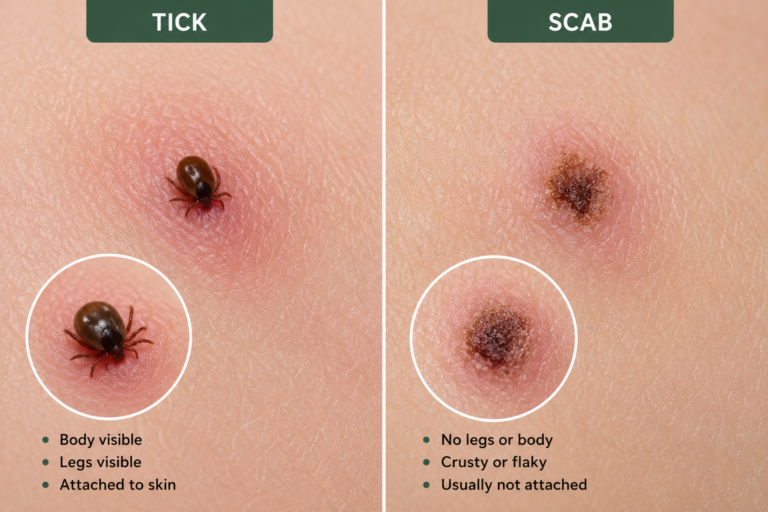
Tick Identification
Tick or Scab? How to Tell the Difference
A tick has a separate body and small legs, while a scab is dried material that forms over damaged or healing skin. However, a very small attached tick can resemble a dark speck or tiny crust.
This guide explains how to compare a tick and a scab without scratching or pulling at the area, and how the Tick Camera can help you inspect a small or unclear spot more closely.
Is It a Tick or a Scab?
Look for a distinct oval or rounded body, small legs and a narrow point where the object is attached. These features suggest a tick.
A scab is usually flat or irregular, rough or crusted and continuous with the damaged skin beneath it. It does not have legs or a separate body.
At a glance:
- Tick: Has a separate body and legs.
- Scab: Forms directly on injured or irritated skin.
- Tick: May look smooth, oval or rounded.
- Scab: Often looks rough, flaky or irregular.
- Tick: May appear after outdoor exposure.
- Scab: May follow a scratch, bite, cut or skin irritation.
- Tick: Can become larger while feeding.
- Scab: Usually dries, shrinks or loosens as the skin heals.
Do not scratch, scrape or pull at the spot while you are unsure. This can damage healing skin or crush an attached tick.
Tick or Scab: Quick Comparison
| Feature | Tick | Scab |
|---|---|---|
| Legs | Usually has visible legs, although they may be hidden | No legs |
| Body | Separate oval, flat or rounded body | Dried material attached directly to damaged skin |
| Shape | Usually compact, oval, seed-like or rounded | Often irregular, flat, flaky or crusted |
| Surface | Often smooth or firm | Often dry, rough or cracked |
| Attachment | Attached at a small point near the front of the body | Covers or forms within an area of healing skin |
| Color | Brown, black, reddish, tan, grey or patterned | Red-brown, dark brown, yellowish or nearly black |
| Movement | Legs may move | No independent movement |
| Change over time | May enlarge while feeding | Usually dries, shrinks or flakes as healing progresses |
| Surrounding skin | May initially appear normal or mildly irritated | May show evidence of a scratch, sore or previous irritation |
No single feature proves what the spot is. Inspect the entire outline, surface and attachment point before deciding what to do.
Signs That the Spot May Be a Tick
A tick is a separate organism attached to the surface of the skin. Its size and appearance vary according to its species, life stage and feeding status.
It has visible legs
Adult ticks and nymphs have eight legs, while larvae have six. The legs are usually grouped around the front or sides of the body.
On a very small tick, the legs may appear only as fine dark lines. Hair, fur and skin folds can also hide them.
It has a separate body
A tick normally has an identifiable body sitting above the skin. It may be flat and oval or swollen and rounded.
A scab usually blends into the damaged surface rather than appearing as a complete organism.
It has a compact outline
Ticks often have an oval, rounded, teardrop or seed-like outline.
A scab is more likely to follow the irregular shape of a scratch, wound or irritated patch.
It is attached at one point
The tick’s mouthparts are located at the front. The body sits above the skin and is attached through a relatively small area.
Do not twist the object or pull at it to test the attachment.
Its surface looks smooth or shell-like
An unfed tick may look flat and firm. A feeding tick may appear smoother, stretched and more rounded.
A scab is more likely to have a rough, flaky, cracked or crusted surface.
It appeared after outdoor exposure
A new unfamiliar spot found after walking, hiking, gardening or spending time in grass, woodland or brush deserves closer inspection.
Dogs and cats may acquire ticks while walking, roaming or resting in vegetation.
It becomes larger over a short period
A feeding tick can expand as it takes a blood meal. The body may become grey, tan, brown, pale or blue-grey.
A scab does not normally become smoothly enlarged in this way.
The legs may move
In some cases, small legs move when surrounding hair or fur is parted. Do not poke or squeeze the object to force movement.
Signs That the Spot May Be a Scab
A scab forms when blood, fluid and other material dry over injured or irritated skin. Its appearance depends on the cause and stage of healing.
It has no legs
A scab has no legs, mouthparts or independent body.
Inspect the full edge carefully because cracks, hairs and shadows can sometimes resemble tiny legs.
It looks rough or crusted
A scab may have an uneven, flaky, cracked or dry surface. It may look different from one side to the other.
A tick usually has a more organized body outline.
It is continuous with the skin
A scab forms directly over or within a damaged area of skin. It does not sit on the skin as a separate organism.
It follows the shape of an injury
The spot may be elongated, irregular or spread across a scratch, bite, sore or irritated patch.
There may be redness around it
The surrounding skin may look pink, red or irritated, particularly if the area has recently been scratched or injured.
Increasing redness, warmth, swelling, discharge or pain may require professional assessment.
It may be itchy or tender
Healing skin can itch or feel sensitive. Avoid scratching because this can reopen the area and delay healing.
It changes as the skin heals
A scab may dry, shrink, crack or loosen gradually. It may eventually fall away once the skin underneath has healed.
There may be more than one crusted area
Skin irritation, scratching, allergies, bites or infections can sometimes cause several scabs or crusted patches.
Multiple unexplained sores should be assessed by a healthcare professional or veterinarian.
Why Can a Small Tick Look Like a Scab?
A small larva or nymph may look like a dark dot or tiny crust, particularly when viewed without magnification.
Confusion is especially common when:
- The tick is extremely small
- The legs are hidden beneath the body
- The spot is covered by hair or fur
- The skin around it is irritated
- The lighting is poor
- The image is blurred
- The tick is partly covered by dried blood or debris
- The spot is located in a skin fold
Use bright light and inspect the object from the side as well as directly above it. A small raised body with legs suggests a tick, while an irregular crust continuous with the skin suggests a scab.
How to Inspect the Spot Safely
Inspect the area without scratching, scraping or pulling at it.
- Move into bright, even lighting.
- Wash your hands before touching the surrounding skin.
- Part hair or fur completely around the spot.
- Look at the area from above and from the side.
- Check for a separate oval or rounded body.
- Look carefully for small legs.
- Inspect where the object meets the skin.
- Check whether the surface is smooth or crusted.
- Use magnification or the Tick Camera when helpful.
- Seek professional advice if the spot remains unclear.
Do not scratch the spot
Scratching can remove a healing scab prematurely or damage an attached tick.
Do not scrape it with a fingernail
A scab may bleed if scraped, while a tick may be crushed or separated incorrectly.
Do not use tweezers until you are reasonably sure
Tweezers should not be used to pull at a mole, scab, skin tag or other unidentified skin feature.
Do not cut around it
Never use scissors, razors or nail clippers near an unclear skin spot.
Take a clear photograph
A photograph in good lighting may help you compare the spot over time or show it to a healthcare professional or veterinarian.
Do not delay removal once an attached tick has been clearly identified and can be reached safely.
Tick or Scab on a Person
On human skin, a small tick can resemble a dark scab, particularly on the scalp, behind the ears, under the arms, around the waist, in the groin or behind the knees.
Ask the following questions:
- Does the spot have visible legs?
- Does it have a separate oval or rounded body?
- Is the surface smooth or crusted?
- Was there a recent scratch, cut or skin irritation?
- Did the spot appear after outdoor exposure?
- Has it become larger over a short period?
- Does it sit above the skin or blend into it?
Check the scalp carefully
Hair can hide both a small tick and a small scab. Part the hair completely around the area and inspect the skin beneath it.
Do not rely only on color
Both ticks and scabs can appear dark brown, reddish brown or almost black.
Seek advice for non-healing areas
A healthcare professional should assess a sore or scab that does not heal, repeatedly bleeds, changes rapidly or is associated with increasing pain or swelling.
Tick or Scab on a Dog
Dogs may develop scabs from scratching, minor injuries, bites, skin irritation and other dermatological conditions. They can also have ticks hidden beneath the fur.
Part the coat completely around the spot before touching it.
Look for legs beneath the fur
A tick may have fine legs hidden against the skin. A scab has no separate legs.
Check the surrounding coat and skin
Hair loss, redness, several crusted spots or signs of repeated scratching may suggest a wider skin problem rather than a single tick.
Check whether the spot is raised
A tick has a body that usually projects above the skin. A scab may be flatter and spread across an irritated area.
Watch the dog’s behaviour
Frequent licking, chewing or scratching may indicate irritation, pain, parasites, allergy or infection.
Ask a veterinarian about unclear or widespread lesions
Skin conditions can have similar appearances. Veterinary assessment is advisable when several scabs are present or the skin is painful, swollen, oozing or not healing.
Tick or Scab on a Cat
Cats may have small crusted spots caused by scratching, bites, skin inflammation or other conditions. A small tick can also be hidden close to the skin.
Keep the inspection short
Use calm, familiar handling and stop if the cat becomes distressed.
Part the fur down to the skin
Do not rely on feeling the surface of the coat. Expose the entire outline of the spot.
Look for a separate body
A tick sits above the skin and may have visible legs. A scab forms directly on the skin.
Do not pull at several crusted spots
Multiple small scabs can indicate a skin condition that requires veterinary assessment.
Seek help if the cat cannot be handled safely
A frightened or painful cat may scratch or bite. Ask a veterinarian to inspect the area when safe handling is not possible.
Could the Spot Be Something Else?
A dark or raised spot may be neither a tick nor a scab.
Mole
A mole is part of the skin and may be flat or raised. It has no legs or separate parasite body.
Skin tag
A skin tag is made of skin tissue and may hang from a narrow stalk. It has no legs.
Wart
A wart may have a rough or uneven surface. Some warts can resemble dried or crusted skin.
Nipple
Small nipples on dogs and cats are commonly mistaken for ticks, particularly when hidden by fur.
Dried blood
Dried blood may form a dark spot over a small injury and can resemble a tick when viewed from a distance.
Dirt or plant material
Dirt, seeds and burrs may become trapped in hair or fur. They are not attached through mouthparts and have no legs.
Another insect
A flea, beetle or other small insect may temporarily sit on the skin or become caught in fur.
What Should You Do If It Is a Tick?
Once you have clearly identified an attached tick, remove it promptly and carefully.
Use clean fine-tipped tweezers or an appropriate tick-removal tool. Grasp the tick as close to the skin as possible and pull upward with slow, steady pressure.
Avoid squeezing or crushing the tick’s body.
Clean the area afterward
Clean the attachment site and wash your hands after handling the tick.
Record the date and location
Note when and where the tick was found. Take a clear photograph when practical.
Monitor the person or pet
Observe the attachment site and general health. Seek medical or veterinary advice if concerning symptoms or changes develop.
Get help for sensitive locations
Seek professional assistance when the tick is close to the eye, deep inside the ear, inside the mouth or in another place where removal cannot be completed safely.
What Should You Do If It Is a Scab?
Do not pull, scratch or peel off a scab. It protects the healing skin beneath it.
Keep the area clean
Follow appropriate skin-care or veterinary guidance. Avoid harsh household chemicals and repeated touching.
Prevent scratching
Scratching can reopen the wound, cause bleeding and increase irritation.
Watch for infection or worsening inflammation
Seek professional advice if the area becomes increasingly red, warm, swollen, painful or begins producing discharge.
Seek advice if it does not heal
A healthcare professional or veterinarian should assess a persistent, recurrent or unexplained scab.
Do not apply human products to pets
Do not use creams, disinfectants or wound products on a dog or cat unless they are confirmed as safe by a veterinarian.
Common Mistakes When Comparing a Tick and Scab
Looking only at color
Ticks and scabs can both be dark brown, reddish or black. Color alone is not reliable.
Scratching the spot to see whether it comes off
This can reopen healing skin or damage an attached tick.
Expecting the tick’s legs to be obvious
Legs can be hidden beneath the body, surrounding hair, fur or a skin fold.
Assuming every rough spot is a scab
A small tick covered by dried material or debris may appear uneven.
Assuming every raised spot is a tick
Scabs, moles, warts, nipples and skin tags can all form raised areas.
Using tweezers too early
Do not pull at a spot with tweezers until you are reasonably sure it is a tick.
Relying only on touch
Both ticks and scabs may feel firm. Visual inspection is essential.
Using excessive digital zoom
Digital zoom can enlarge blur. Use good lighting and move only as close as the camera can focus clearly.
Waiting after clearly identifying a tick
Once an attached tick is confirmed and accessible, remove it promptly using an appropriate method.
Frequently Asked Questions About Ticks and Scabs
What is the easiest way to tell a tick from a scab?
Look for a separate oval or rounded body and small legs. A scab is dried material attached directly to damaged skin and usually has an irregular or crusted surface.
Can a small tick look like a scab?
Yes. A very small larva or nymph may resemble a dark speck or tiny crust, especially when its legs are hidden.
Can a scab be raised like a tick?
Yes. A thick scab can be raised above the surrounding skin. It still has no separate legs or organized parasite body.
Does a tick always have visible legs?
No. The legs may be hidden beneath the body, hair, fur or a skin fold. Inspect the spot from more than one angle.
Should I scratch the spot to see whether it is a scab?
No. Scratching can cause bleeding, reopen healing skin or damage an attached tick.
Can a tick be covered in dried blood?
A tick and the surrounding attachment site may sometimes be partly obscured by dried blood, debris or irritated skin. Use bright lighting and inspect the outline carefully.
Can dogs and cats get scabs from tick bites?
Skin irritation can remain after a tick bite or removal. However, scabs in pets can have many causes and should be assessed by a veterinarian when persistent, widespread or inflamed.
What should I do if the spot starts bleeding?
Apply gentle pressure with clean material and seek medical or veterinary advice if bleeding continues, the area is painful or the cause is unclear.
What should I do if I still cannot tell the difference?
Do not scratch, cut or pull at the spot. Take a clear photograph and ask a healthcare professional or veterinarian to inspect it.
Should a confirmed tick be removed promptly?
Yes. Use fine-tipped tweezers or an appropriate tick-removal tool and grasp the tick close to the skin before pulling upward with steady pressure.
Your Next Step
Sources
This guide was prepared using information from recognized public-health and veterinary organizations.
Centers for Disease Control and Prevention: Tick Lifecycles ↗
Centers for Disease Control and Prevention: DPDx – Ticks ↗
Centers for Disease Control and Prevention: What to Do After a Tick Bite ↗
Merck Veterinary Manual: Skin Tumors in Dogs ↗
Merck Veterinary Manual: Mite Infestation and Skin Irritation in Dogs ↗
Learn more about our research and review process in our Editorial Policy and Sources and References.