
Tick Removal Guide
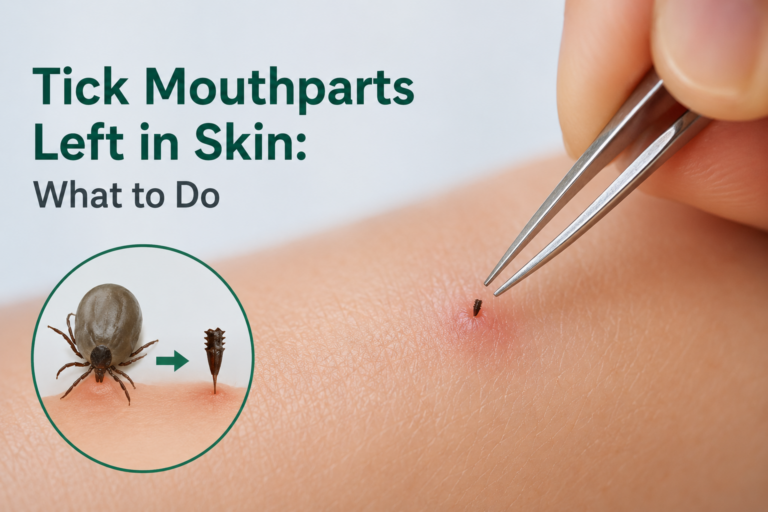
Tick Mouthparts Left in Skin: What to Do
If tick mouthparts remain in the skin after removal, try to remove them only when they can be grasped easily with clean fine-tipped tweezers. If they cannot be removed easily, leave them alone, keep the area clean and allow the skin to heal.
This guide explains how to recognize possible retained tick mouthparts, what not to do, how to care for the bite and how the Tick Camera can help you inspect and document the area.
What Should You Do if Tick Mouthparts Are Left in the Skin?
First, remain calm. A tiny dark point after tick removal does not necessarily mean that the entire tick or its head remains in the skin.
Follow these steps:
- Move into bright, even lighting.
- Wash your hands.
- Clean the bite area gently.
- Inspect the small dark point without squeezing it.
- Use clean fine-tipped tweezers only if the fragment is clearly visible and easy to grasp.
- Do not dig, cut or repeatedly scrape the skin.
- Leave the fragment alone if it cannot be removed easily.
- Photograph the area for later comparison.
- Monitor the bite as the skin heals.
- Seek medical advice if redness, swelling, pain or discharge increases.
The skin will often push a small retained fragment outward naturally as it heals.
What Part of the Tick Can Remain in the Skin?
People often describe the problem as the tick’s “head” being left behind. In many cases, however, the visible fragment is part of the tick’s mouthparts rather than an entire separate head.
The mouthparts attach the tick to the skin
A tick uses specialized feeding structures at the front of its body to remain attached while feeding.
These structures can sometimes break when the tick is twisted, jerked or gripped incorrectly during removal.
The fragment may be extremely small
Retained mouthparts may look like:
- A tiny black dot
- A dark splinter-like point
- A small brown fragment
- A pinpoint crust
- A dark spot in the centre of the bite
A dark dot may also be a scab
Not every dark point is a retained tick fragment. It may instead be:
- Dried blood
- A tiny scab
- Local skin pigmentation
- Dirt or debris
- A small puncture mark
- A normal part of the healing process
Do not scrape the area simply to find out whether the dark point comes off.
The tick’s body should no longer be present
After successful removal, the oval or rounded body of the tick should no longer be attached.
If a larger body with legs is still visible, the tick may not have been completely removed.
Why Do Tick Mouthparts Break Off?
Mouthparts are more likely to remain when removal is hurried or the tick is not gripped close enough to the skin.
The tick was twisted
Twisting an ordinary pair of tweezers can separate the tick’s body from the structures attached to the skin.
Some purpose-designed removal tools use a different technique. Follow the instructions supplied with the specific tool.
The tick was pulled suddenly
A fast or jerking movement can cause the tick to break before the mouthparts release.
The tick was gripped by the body
Gripping the enlarged abdomen rather than close to the skin can make removal less controlled.
The tweezers slipped
Broad, blunt or poorly aligned tweezers may not hold the tick securely near the attachment point.
The tick was very small
A larva or nymph can be difficult to grip accurately without pinching the skin.
The location was difficult to reach
Ticks attached in hair, skin folds, near an eye or between toes may be harder to remove in one controlled movement.
How to Remove Visible Tick Mouthparts
Attempt removal only when the fragment is clearly visible, close to the surface and easy to grasp.
1. Wash your hands
Wash and dry your hands before touching the bite area.
2. Move into bright lighting
Use natural daylight or bright, even indoor lighting.
Avoid harsh glare that makes the centre of the bite difficult to see.
3. Clean the tweezers
Use clean fine-tipped tweezers. The tips should meet evenly and be narrow enough to grasp a tiny fragment.
4. Clean the surrounding skin
Gently clean the bite area with soap and water, rubbing alcohol or another appropriate skin-cleaning method.
Do not scrub aggressively.
5. Inspect before touching
Confirm that the fragment projects enough from the skin to be grasped without digging.
6. Position the tweezers carefully
Place the tips around the visible fragment as close to the surface of the skin as possible.
Avoid pinching the surrounding skin.
7. Pull gently
Use a slow and controlled movement.
Stop if the fragment does not release easily or if you begin pulling or tearing the skin.
8. Clean the area again
After the fragment is removed, clean the bite area gently.
9. Wash your hands
Wash your hands and clean the tweezers after the procedure.
10. Photograph the area
Take a clear image showing the centre of the bite and the surrounding skin.
This provides a useful starting point for monitoring changes.
When Should You Leave Tick Mouthparts Alone?
Leave the fragment alone if it cannot be removed easily with clean fine-tipped tweezers.
Do not continue attempting removal when:
- The fragment is level with or beneath the skin
- You cannot see its edges clearly
- The tweezers repeatedly slip
- The skin begins bleeding
- The area becomes increasingly painful
- You would need to dig into the skin
- The fragment may be a scab rather than mouthparts
- The bite is close to an eye or other sensitive structure
The skin may expel the fragment naturally
As the skin heals, a small retained fragment may gradually move toward the surface and fall out.
A tiny local reaction may occur
The area may temporarily remain red, slightly raised or irritated.
Do not repeatedly check with tweezers
Repeated attempts can cause more irritation than the retained fragment itself.
Do not reopen the wound
A small puncture should not be enlarged by cutting, scraping or digging.
Is It Dangerous to Leave Tick Mouthparts in the Skin?
A small retained fragment most commonly causes a local skin reaction rather than continuing the tick’s feeding process.
The remaining fragment cannot continue feeding
Once the tick’s body has been removed, the retained mouthparts cannot continue taking a blood meal.
Local irritation can occur
The body may react to the fragment in a way similar to a tiny splinter.
This can cause:
- A small red spot
- A firm bump
- Mild swelling
- Tenderness
- Itching
- A small scab
Digging can increase the risk of infection
Cutting or repeatedly probing the area can introduce bacteria and cause more tissue damage.
Monitor the person rather than the fragment alone
Continue watching the bite area and general health after any tick bite, whether or not a small fragment remains.
Do Retained Mouthparts Increase the Risk of Lyme Disease?
The main concern for transmission of a tick-borne infection is the period during which the living tick was attached and feeding.
A tiny retained fragment after the tick’s body has been removed does not continue feeding.
However, you should still monitor the bite and your general health because:
- The tick may already have been attached for some time
- The exact attachment duration may be unknown
- Different ticks can transmit different pathogens
- Symptoms may appear after the tick has been removed
- Not every relevant symptom includes a visible rash
Seek medical advice if a spreading rash, fever, headache, unusual tiredness, muscle pain, joint pain, facial weakness or other concerning symptoms develop.
How Long Can Tick Mouthparts Remain in the Skin?
There is no exact time that applies to every bite. A very small fragment may work its way out over several days as the skin heals.
It may become part of a small scab
The fragment can be covered by dried blood or healing tissue.
The dark point may become less visible
As swelling and irritation settle, the centre may gradually fade.
A small bump may last longer
Local inflammation can sometimes persist after the fragment itself is no longer visible.
Persistent irritation should be assessed
Seek advice if the site remains painful, swollen, warm, draining or does not improve.
How Should You Clean the Bite Area?
Keep the area clean while avoiding unnecessary irritation.
Wash gently
Use soap and water, rubbing alcohol or another appropriate skin-cleaning method.
Pat the area dry
Avoid rough rubbing with a towel.
Do not repeatedly apply harsh products
Repeated use of strong chemicals can irritate the skin and make redness more difficult to assess.
Do not squeeze the bite
Squeezing will not force deeply retained mouthparts out and may increase swelling.
Avoid scratching
Scratching can reopen the skin and introduce bacteria.
Use a light dressing only when needed
A clean dressing may help if the area rubs against clothing or remains slightly open.
Do not cover the area tightly or keep it unnecessarily moist.
How to Monitor the Skin After Tick Removal
Check the bite without repeatedly touching or manipulating it.
Record the removal date
Write down when the tick was found and removed.
Record the bite location
Note the exact body area where the tick was attached.
Take a baseline photograph
Photograph the area in bright, neutral lighting.
Take one close and one wider image
The close image shows detail. The wider image helps show whether redness expands beyond the original bite.
Use similar conditions for later photographs
Use approximately the same lighting, angle and camera distance.
Watch the centre
Notice whether the dark point remains stable, becomes less visible or develops discharge.
Watch the surrounding skin
Monitor whether redness and swelling remain small, fade or expand.
Monitor general health
Pay attention to:
- Fever or chills
- Headache
- Unusual tiredness
- Muscle aches
- Joint pain
- A spreading rash
- Swollen lymph nodes
- Facial weakness
- Numbness or neurological symptoms
- Other unexplained illness
What Skin Changes Can Occur While the Area Heals?
A small red or discolored spot
Local irritation may appear red, pink, purple, brown or darker than the surrounding skin.
A small firm bump
A temporary bump can develop as the skin reacts to the bite or retained fragment.
A tiny scab
Dried blood or healing skin may form a small crust over the centre.
Mild itching
Itching can occur during healing. Avoid scratching.
Slight tenderness
The area may feel mildly sensitive for a short time after removal.
A visible dark point
A tiny central point can remain while the skin heals.
These changes should generally be monitored for improvement rather than repeatedly manipulated.
What Are Signs of a Local Skin Infection?
Seek medical advice if the area becomes progressively more inflamed rather than gradually improving.
Possible signs include:
- Increasing redness
- Increasing swelling
- Worsening pain
- Warmth around the bite
- Pus or cloudy discharge
- Persistent bleeding
- Red streaks extending from the area
- Increasing tenderness
- Fever or feeling generally unwell
Do not squeeze out discharge
Squeezing can push inflammation deeper and cause additional injury.
Do not use leftover antibiotics
Do not use medication prescribed for another person or an earlier illness.
Tell the clinician about the tick
Explain when the tick was removed and that a small fragment may have remained.
When Should You Contact a Healthcare Professional?
Seek medical advice when the fragment, bite area or later symptoms cause concern.
Contact a healthcare professional if:
- The fragment is close to the eye
- The fragment is deep inside the ear
- The fragment is inside the mouth
- The area becomes increasingly painful
- Redness or swelling continues to spread
- The bite becomes warm or produces discharge
- Bleeding does not stop
- A circular, oval or expanding rash develops
- You develop fever or chills
- You develop headache or unusual tiredness
- You develop muscle or joint pain
- You develop facial weakness
- You develop numbness or other neurological symptoms
- You are medically vulnerable and concerned about the bite
- You remain unsure whether part of the tick is still attached
Seek urgent help for severe symptoms
Seek urgent medical assistance for breathing difficulty, fainting, confusion, severe weakness, chest symptoms, severe headache or rapidly worsening illness.
Do not wait for a perfect bull’s-eye rash
A concerning rash does not always have a target-like appearance.
Bring useful information
Provide:
- The date of removal
- The bite location
- The likely exposure location
- Photographs of the tick or bite
- Any symptoms and when they began
Tick Mouthparts Left in a Child’s Skin
The same general guidance applies to children, but extra care is needed to avoid frightening or injuring the child.
Keep the child calm
Explain that a very small piece may remain and that you are only going to look at it.
Do not force the child to remain still for repeated attempts
Sudden movement can cause injury when tweezers are close to the skin.
Remove the fragment only when it is easy to grasp
Do not dig into a child’s skin with tweezers or a needle.
Protect the child’s privacy
Use appropriate covering and explain before examining sensitive areas.
Monitor symptoms carefully
Children may not describe headache, fatigue or muscle discomfort clearly.
Watch for changes in energy, appetite, activity, mood and temperature.
Seek medical advice when uncertain
Professional help is appropriate when the area is near an eye, the child cannot remain still or the skin becomes increasingly inflamed.
Tick Mouthparts Left in a Dog’s Skin
A small retained fragment in a dog can cause local irritation. Avoid digging into the skin, especially when the dog is moving or distressed.
Part the fur completely
Expose the bite area before deciding whether a fragment is visible.
Use only clean fine-tipped tweezers
Attempt removal only when the fragment can be grasped easily without digging.
Prevent licking and scratching
Repeated licking can increase irritation and introduce bacteria.
Use only dog-safe products
Do not apply human creams, painkillers or disinfectants unless a veterinarian has confirmed they are safe.
Contact a veterinarian if the area worsens
Seek advice for increasing pain, swelling, discharge, heat or persistent irritation.
Tick Mouthparts Left in a Cat’s Skin
Do not force a cat to remain still while repeatedly attempting to remove a tiny fragment.
Keep the inspection short
Use calm, familiar handling and bright lighting.
Stop if the cat becomes distressed
A frightened or painful cat may scratch or bite.
Do not dig into the skin
Leave a fragment alone if it cannot be grasped easily.
Do not apply human skin products
Only use cleaning or wound-care products confirmed as safe for cats.
Contact a veterinarian when necessary
Seek advice if the fragment is near the eye, deep inside the ear, the cat cannot be handled safely or the area becomes increasingly irritated.
Common Mistakes When Mouthparts Remain
Digging with a needle
A needle can push bacteria into the skin and cause unnecessary injury.
Cutting the skin
Do not use a blade, scissors or nail clippers to enlarge the puncture.
Squeezing the bite
Squeezing is unlikely to push the fragment out and can increase inflammation.
Repeatedly scraping with a fingernail
This can damage healing skin and introduce bacteria.
Using dirty tweezers
Only use clean fine-tipped tweezers.
Continuing after the skin begins bleeding
Stop repeated attempts and allow the area to heal.
Assuming every dark dot is a tick fragment
The spot may be dried blood, a scab or normal pigmentation.
Applying strong household chemicals
Bleach, concentrated disinfectants, nail polish remover and similar substances can injure the skin.
Ignoring a worsening bite
Increasing pain, swelling, warmth or discharge should be assessed.
Watching only the bite and ignoring general symptoms
Monitor overall health after a tick bite as well as the skin.
Frequently Asked Questions About Tick Mouthparts Left in Skin
Can tick mouthparts remain in the skin?
Yes. The mouthparts can occasionally break off during removal, especially if the tick is twisted, jerked or gripped too far from the skin.
Is the entire tick’s head left behind?
Usually the small retained material consists of mouthparts or feeding structures rather than a complete separate head.
Should I remove tick mouthparts?
Remove them only when they are clearly visible and easy to grasp with clean fine-tipped tweezers. Otherwise, leave them alone and let the skin heal.
Should I dig tick mouthparts out with a needle?
No. Digging can cause additional skin injury, bleeding and infection.
Will the body push tick mouthparts out?
A small retained fragment may gradually work its way out as the skin heals.
How long do tick mouthparts remain in the skin?
The timing varies. A small fragment may fall out over several days, while local irritation or a small bump can sometimes last longer.
Can retained mouthparts continue transmitting disease?
Once the tick’s body has been removed, the retained fragment cannot continue feeding. You should still monitor for symptoms because transmission may have occurred while the tick was attached.
Can tick mouthparts cause an infection?
They can cause local irritation, and damaged skin can become infected. Seek advice if redness, swelling, warmth, pain or discharge increases.
What does a retained fragment look like?
It may appear as a tiny black, brown or splinter-like point in the centre of the bite. A small scab or dried blood can look similar.
What should I put on the bite?
Clean the area gently with soap and water, rubbing alcohol or another appropriate skin-cleaning method. Avoid harsh household chemicals.
Should I cover the bite?
A small clean bite may not need covering. A light clean dressing can help when the area rubs against clothing or remains slightly open.
Is a red spot normal afterward?
A small local red or discolored spot can occur after tick removal. Seek medical advice if it expands, becomes increasingly painful or is accompanied by other symptoms.
When should I contact a doctor?
Seek medical advice for increasing redness, swelling, pain, warmth, discharge, a spreading rash, fever, headache, unusual tiredness, joint pain, facial weakness or other concerning symptoms.
What if mouthparts remain near the eye?
Do not attempt repeated removal close to the eye. Seek professional medical assistance.
What if mouthparts remain in my dog or cat?
Do not dig into the skin. Keep the area clean, prevent licking or scratching and contact a veterinarian if irritation increases or the animal cannot be handled safely.
Your Next Step
Sources
This guide was prepared using information from recognized public-health organizations.
Centers for Disease Control and Prevention: What to Do After a Tick Bite ↗
Centers for Disease Control and Prevention: Mosquitoes, Ticks and Other Arthropods ↗
Centers for Disease Control and Prevention: Signs and Symptoms of Lyme Disease ↗
NHS: Lyme Disease and Tick Removal ↗
NHS: Tick-Borne Encephalitis and Tick Removal ↗
UK Health Security Agency: Lyme Disease Signs and Symptoms ↗
Learn more about our research and review process in our Editorial Policy and Sources and References.