
Practical Guidance and Information
Tick Guides: Find, Identify, Remove and Respond
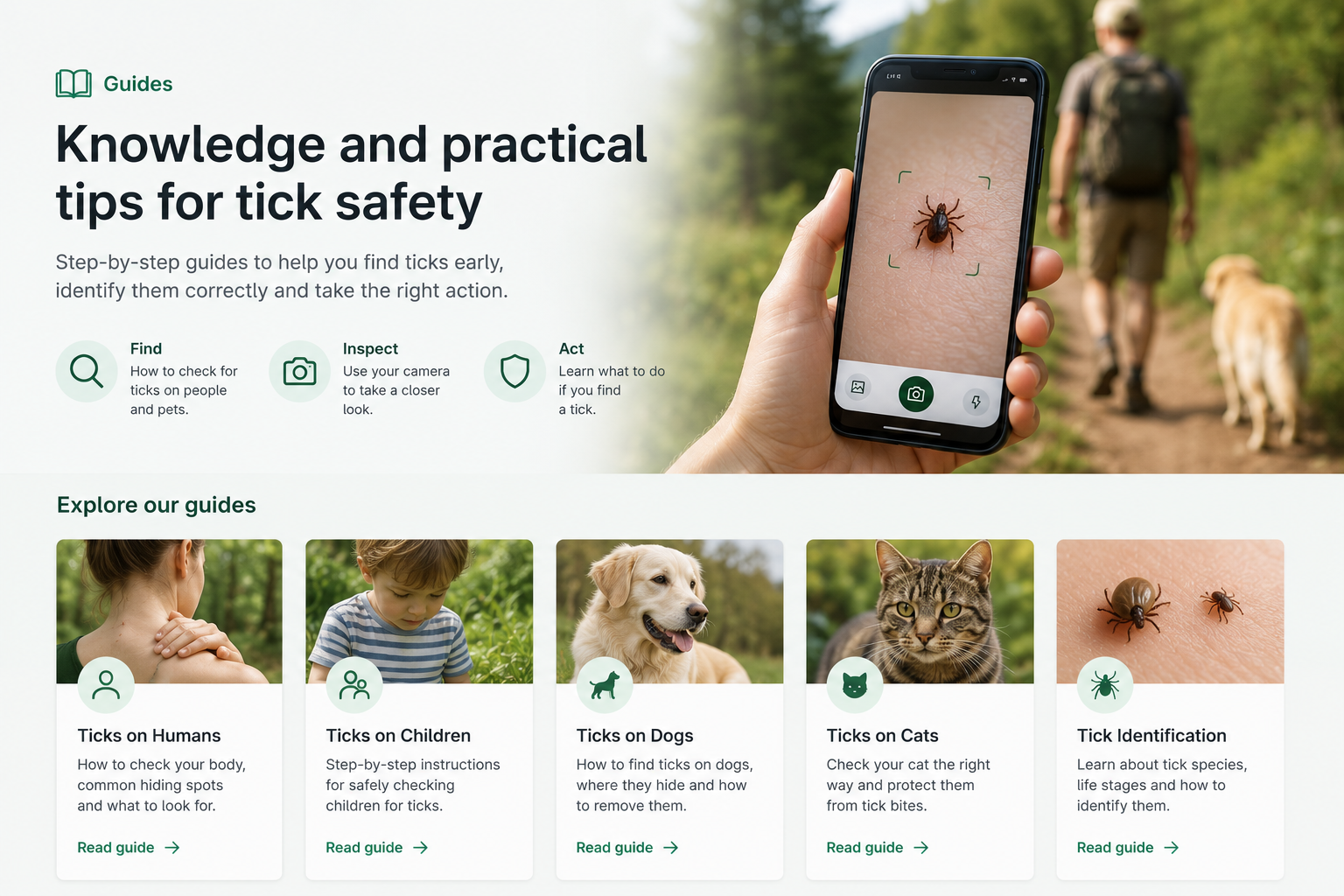
Are you checking for ticks, examining a suspicious spot, removing an attached tick or monitoring changes after a tick bite? Explore our central guides for adults, children, dogs and cats.
Choose the topic that best matches your current situation. From checking after outdoor activities to monitoring a changing bite area, each guide leads you toward the next practical step.
What Would You Like to Do?
Choose the main guide that matches what you need help with right now.
All Tick Guides by Topic
Our guides are organized around practical situations. The main guides provide a complete overview, while the detailed articles answer specific questions in greater depth.
Checking for ticks
Use these guides after hiking, gardening, outdoor play or any other activity where contact with ticks may have occurred.
How to Check the Human Body for Ticks →
How to Check for Ticks After Hiking →
Identifying a possible tick
A small dark spot or raised object is not automatically a tick. These guides help you examine common features and compare possible look-alikes.
What Does a Tick Look Like? →
Tick or Skin Tag? →
What Does an Engorged Tick Look Like? →
Removing a tick
A clearly attached tick should be removed carefully and without unnecessary delay. These guides explain the correct technique and what to do afterward.
What to Do After Removing a Tick →
What If Tick Mouthparts Stay in the Skin? →
Monitoring a tick bite
Not every small local skin reaction is automatically a sign of illness. The size, development and accompanying symptoms are more important than a single appearance.
Ticks on Children
Children should be checked particularly carefully after outdoor activities. The scalp, hairline, areas behind the ears and other protected parts of the body can easily be overlooked.
The main guide explains the complete checking process. The detailed guide focuses on the places where ticks may be especially difficult to find.
Ticks on Dogs and Cats
Small ticks can be difficult to find beneath a dog’s or cat’s coat. The correct checking and prevention routine depends on the animal, coat type, lifestyle and local risk.
Choose the guide for your pet and keep handling calm, controlled and safe.
Ticks on dogs
Learn how to check a dog systematically, where ticks commonly hide, how to respond when one is found and which changes should be assessed by a veterinarian.
Ticks on cats
The cat guide explains how to inspect the coat with minimal stress, examine a suspicious spot and use only tick-prevention products that are suitable for cats.
Preventing Tick Bites Outdoors
Protective clothing, suitable repellents, careful route choices and a thorough check after returning indoors can help reduce the chance of an unnoticed tick bite.
Which Guide Matches Your Situation?
It is not always obvious which guide is the best place to begin. Use these common situations to find the most relevant next step.
You have just returned from hiking or an outdoor area
Check clothing, equipment, skin and hair as soon as practical.
You see a very small dark spot
Small ticks can resemble dirt, a scab, a seed or another minor skin feature.
You are unsure whether it is a tick or skin tag
Do not pull at an uncertain raised skin feature before examining it carefully.
You found a swollen or rounded tick
A feeding tick can become much larger and look very different from an unfed tick.
You found an attached tick
Go directly to the step-by-step removal instructions.
The tick has already been removed
Clean the area, record the date and continue to monitor the bite site.
A small dark fragment remains visible
Do not dig aggressively into the skin. First determine whether the visible point may be dried blood, a puncture mark or retained material.
The bite area is red
A small immediate reaction is not automatically an expanding tick-bite rash. Monitor its size, shape and development.
The skin change is visibly expanding
An expanding or unusual rash after a tick bite should be medically assessed.
You are checking a child
Use the guides written specifically for checking children.
You are checking a pet
Choose the appropriate guide for the animal.
All Detailed Tick Guides
These focused guides answer common questions that arise while checking, identifying, removing or monitoring a tick.
Frequently Asked Questions About Our Tick Guides
Where should I begin if I think I see a tick?
Start with How to Identify a Tick when you need to examine a specific spot. Use How to Check for Ticks when you want to inspect the whole body or a pet.
How should I check for ticks after hiking?
Inspect your clothing, equipment, skin and hair as soon as practical. Follow the detailed routine in How to Check for Ticks After Hiking.
What should I do if the possible tick is extremely small?
Use bright lighting and magnification to look for a distinct body, legs and attachment point. Review What Does a Tick Look Like? and How to Identify a Tick.
How can I distinguish a tick from a skin tag?
Do not pull at an uncertain raised skin feature. Use the comparison guide Tick or Skin Tag?.
What should I do when I find an attached tick?
Remove it carefully and without unnecessary delay. Follow How to Remove a Tick Safely.
What should I do immediately after tick removal?
Clean the bite area, wash your hands, record the date and monitor the skin. See What to Do After Removing a Tick.
What if part of the tick appears to remain?
Do not repeatedly dig into the skin. Guidance is available in What If Tick Mouthparts Stay in the Skin?.
Is every red mark after a tick bite an expanding rash?
No. A small local reaction is not automatically an expanding tick-bite rash. Monitor the development and review Tick Bites.
Are there separate guides for children?
Yes. Start with Ticks on Children and use Where Ticks Hide on Children for the areas most likely to be overlooked.
Are there separate guides for dogs and cats?
Yes. Use Ticks on Dogs or Ticks on Cats depending on the animal.
Can the Tick Camera identify a tick automatically?
No. The Tick Camera is a visual checking aid. It does not automatically identify ticks and does not replace medical or veterinary assessment.
Go Directly to a Main Guide
Quality and Sources
Our guides are prepared and reviewed using suitable, reliable sources. For health information, we prioritize recognized public-health and medical organizations. Pet guides also consider veterinary and parasitology resources.
Learn more about our research process, source selection and editorial standards in our Editorial Policy and Sources and References.