
Tick Identification
What Does an Engorged Tick Look Like?
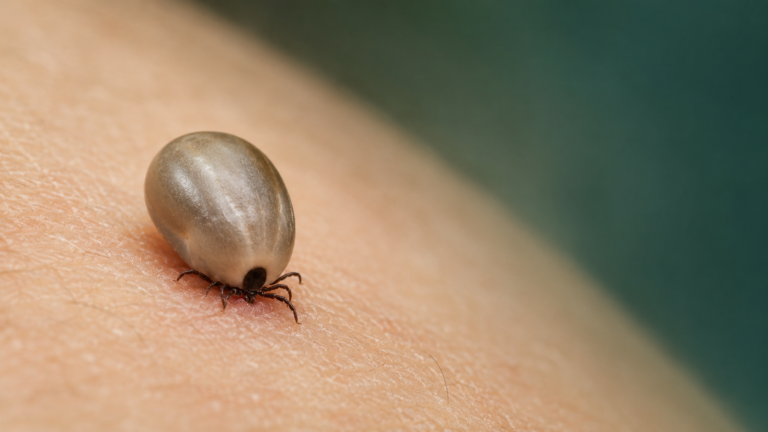
An engorged tick usually has a swollen, rounded or bean-shaped body that is much larger than it was before feeding. Its abdomen may look grey, blue-grey, tan, pale brown or reddish, while the legs and front of the body often remain darker.
This guide explains how an engorged tick changes while feeding, how to distinguish it from skin tags, scabs and other lumps and how the Tick Camera can help you inspect a suspicious spot more closely.
What Does an Engorged Tick Look Like at a Glance?
An engorged tick is a tick that has taken a blood meal and expanded. It may look very different from the flat, compact tick that originally attached.
Typical features include:
- A swollen oval, rounded or bean-shaped body
- A smooth or stretched-looking abdomen
- Grey, blue-grey, tan, pale brown or reddish coloring
- A darker head area and darker legs
- Small legs clustered near the front of the body
- A narrow attachment point at the skin
- A body that sits clearly above the skin
- A firm rather than soft appearance
The legs may look unusually small compared with the swollen abdomen. They can also be hidden beneath the tick, surrounding hair, fur or a skin fold.
Do not assume that a smooth pale lump is a skin tag. Inspect the entire outline and attachment point before touching or attempting removal.
Main Features of an Engorged Tick
A tick’s appearance changes as its abdomen expands during feeding. Several features can help distinguish an engorged tick from a normal skin growth or piece of debris.
A swollen body
The most noticeable feature is the enlarged abdomen. It may appear rounded, oval, pear-shaped or similar to a small bean.
The body can become many times larger than it was before feeding.
A smooth or stretched surface
The expanded abdomen often looks smoother than the body of an unfed tick.
Depending on the feeding stage and species, the surface may appear:
- Smooth
- Firm
- Slightly wrinkled
- Stretched
- Shiny in strong lighting
- Matt under softer lighting
A pale or grey abdomen
Many engorged ticks become lighter as they expand.
The abdomen may appear:
- Grey
- Blue-grey
- Greenish-grey
- Tan
- Pale brown
- Pinkish
- Reddish brown
Color varies widely and should never be used as the only identification feature.
A darker front section
The front of the tick may remain darker than the swollen abdomen. This area contains the mouthparts and is located close to the attachment site.
Small dark legs
Nymphal and adult ticks have eight legs. On an engorged tick, the legs may appear very small relative to the enlarged body.
Look carefully around the front and sides. The legs may be partly hidden beneath the abdomen.
A separate body sitting above the skin
An engorged tick has a distinct outer body rather than being continuous with the skin.
Its abdomen normally projects outward, while the mouthparts attach at a much smaller point near the front.
A narrow attachment point
The large abdomen is not connected to the skin across its entire underside. The actual attachment point is much smaller and located near the tick’s front end.
This feature can help distinguish a tick from a wider skin lump.
How Big Can an Engorged Tick Become?
The size depends on the species, life stage, sex and how much the tick has fed.
A feeding female tick can become significantly larger than an unfed adult. It may resemble:
- A small seed
- A lentil
- A pea
- A small bean
- A rounded bead
These comparisons are only approximate. Some engorged ticks remain smaller, while others become noticeably larger.
Partially fed tick
A partially fed tick may be slightly thicker and more rounded than an unfed tick but still retain much of its original shape.
The abdomen may look:
- Moderately swollen
- Oval rather than flat
- Brown or reddish
- Firm and compact
More heavily engorged tick
A heavily fed tick may have a much larger abdomen and a relatively small-looking front section.
It may appear:
- Rounded
- Pear-shaped
- Grey or blue-grey
- Smooth and stretched
- Top-heavy compared with its legs
Very small engorged nymph
A nymph can also become swollen while remaining much smaller than an adult female.
A fed nymph may resemble a tiny raised seed or dark rounded speck.
Size does not reveal the exact attachment time
A larger tick may have been feeding longer than a flat tick, but size alone cannot determine exactly when attachment occurred.
Species, life stage and individual variation also affect the appearance.
What Color Is an Engorged Tick?
There is no single engorged-tick color. Lighting, species, feeding stage and camera settings can all change the visible appearance.
Grey or blue-grey
This is one of the most commonly described appearances. The abdomen may look pale grey while the legs and front remain dark.
Tan or pale brown
Some engorged ticks appear beige, tan or light brown.
Reddish brown
A partially fed tick may retain a darker reddish-brown appearance.
Greenish-grey
Under some lighting conditions, a grey tick may develop a faint greenish tone.
Pinkish or flesh-colored
A pale expanded tick can sometimes look pinkish or similar to surrounding skin, increasing confusion with a skin tag.
Dark brown or black
Not every fed tick becomes pale. Some remain largely dark, particularly when only partly fed.
Why phone images can change the color
Automatic white balance, flash, shadows and image processing may make the same tick appear different in separate photographs.
Body shape, legs and attachment point are generally more useful than color alone.
How Does a Tick Change While Feeding?
The change occurs gradually. The tick does not immediately become large and grey after attachment.
Before feeding
An unfed tick is usually flatter, more compact and easier to recognize as an arachnid.
You may clearly see:
- The oval body
- The legs
- The darker upper shield
- Species-specific markings
Early feeding stage
The body begins to thicken, but the tick may still look relatively flat.
The original markings and outline may remain visible.
Partially engorged stage
The abdomen becomes wider and more rounded. The legs begin to look smaller in proportion to the body.
The color may start becoming lighter or greyer.
Heavily engorged stage
The abdomen becomes strongly expanded. The body may look smooth, pale and bean-like.
Species markings can become stretched or difficult to see.
Why identification becomes harder
As the abdomen expands, features normally used for species identification can become distorted or hidden.
These may include:
- Body proportions
- Festoons along the rear edge
- Grooves on the body
- Surface markings
- The shape of the shield
- Details on the underside
Exact species identification is often more difficult from an engorged specimen than from an unfed adult.
Where Are the Legs on an Engorged Tick?
The legs are usually located near the front half of the tick rather than evenly distributed around the swollen body.
Look near the attachment point
Inspect the darker front section close to the skin.
Look beneath the body
The swollen abdomen may hang over the legs and hide them from a direct top-down view.
Check from the side
A side angle can reveal small legs that are invisible from above.
Part hair or fur completely
Loose strands can cover the legs and create the impression of a smooth skin growth.
Do not poke the tick to make the legs move
Movement may help confirm that the object is an organism, but intentionally poking or squeezing the tick is unnecessary.
Use visual inspection and remove the tick correctly once identified.
What Does an Engorged Tick Look Like on Human Skin?
On human skin, an engorged tick may look like a rounded grey, brown or pale lump attached at one narrow point.
It sits above the skin
The abdomen usually projects outward rather than forming part of the skin itself.
The legs may be visible at the base
Look around the darker front section near the attachment point.
It can resemble a skin tag
A pale body and hidden legs can make the tick look like a smooth skin growth.
It may be found in a protected area
Commonly overlooked areas include:
- The scalp
- Behind the ears
- Under the arms
- Around the waist
- Inside the belly button
- The groin
- Behind the knees
- Between the toes
The surrounding skin may look normal
A tick can remain attached without causing dramatic redness or swelling.
A small red area may be present
Local irritation can occur around the attachment point, but the appearance alone cannot diagnose an infection.
What Does an Engorged Tick Look Like on a Child?
An engorged tick on a child may resemble a pale bean, raised skin bump or small rounded growth.
Check the hair and scalp carefully
Hair can hide the legs and attachment point while leaving only the enlarged abdomen visible.
Look behind the ears
The folds behind the ears can conceal much of the tick.
Check skin folds
Inspect the armpits, waist, groin and behind the knees.
Do not pull at an unfamiliar lump
Use bright lighting and inspect the object fully before attempting removal.
Keep the child calm
Explain that you need to look at a small outdoor tick and that you will be careful.
Get help for sensitive locations
Seek medical assistance if the tick is attached directly to an eyelid, deep inside the ear or in another location where safe removal is difficult.
What Does an Engorged Tick Look Like on a Dog?
On a dog, an engorged tick may feel like a firm pea, bean or rounded skin lump hidden beneath the fur.
The abdomen may be grey or pale brown
The color can contrast with dark fur but may blend into lighter coats.
The legs may be hidden
Part the fur completely around the base and inspect from the side.
It may resemble a nipple
Nipples occur in regular rows along the underside of the dog. Check the location and look for legs before touching the bump.
It may resemble a skin tag
A smooth pale abdomen can appear similar to a benign skin growth.
Common dog locations
Pay particular attention to:
- The ears
- The eyelids
- The muzzle
- Under the collar
- The armpits
- The belly
- The groin
- Between the toes
- The base of the tail
Do not squeeze the abdomen
Grip the tick close to the dog’s skin when removing it rather than holding the swollen body.
What Does an Engorged Tick Look Like on a Cat?
On a cat, an engorged tick may appear as a firm rounded bump beneath the fur, particularly around the head, ears and neck.
Part the coat down to the skin
Do not rely only on feeling the surface.
Look for darker legs near the front
The legs may be almost completely hidden beneath the swollen body.
Compare with nipples and normal skin features
Do not pull at a bump until you have checked its location and attachment point.
Keep handling brief
Stop if the cat becomes distressed, hisses, struggles or attempts to bite.
Ask a veterinarian when uncertain
Veterinary assistance is appropriate when the tick is near an eye, deep inside the ear or cannot be reached safely.
What Can an Engorged Tick Be Mistaken For?
The enlarged abdomen can resemble several skin features and pieces of debris.
Skin tag
A skin tag consists of skin tissue and has no legs or separate outer body.
An engorged tick has a distinct abdomen and legs near the front, although they may be hidden.
Scab
A scab is dried material formed on injured skin. It is usually rough, crusted or irregular.
An engorged tick normally has a more organized oval or rounded shape.
Mole
A mole is part of the skin and has no independent legs or parasite body.
A mole may be flat or raised but generally does not appear suddenly after outdoor exposure.
Wart
A wart may have a rough or irregular surface rather than a smooth, stretched abdomen.
Nipple
Nipples on dogs and cats can resemble small ticks beneath fur.
They normally occur in a symmetrical arrangement and are continuous with the skin.
Cyst or skin lump
A cyst usually forms within or beneath the skin rather than sitting above it as a separate organism.
Seed or burr
Plant material may be trapped in fur but is not attached through mouthparts and has no moving legs.
Blood blister
A blood-filled skin lesion is part of the skin itself and does not have a separate body or legs.
Another insect
A beetle or other insect may be caught in fur. Ticks do not have wings or long antennae.
Engorged Tick or Skin Tag: Quick Comparison
| Feature | Engorged tick | Skin tag |
|---|---|---|
| Legs | Small legs near the front or sides | No legs |
| Body | Separate swollen body | Made from skin tissue |
| Attachment | Narrow attachment point near the front | Connected by a skin base or stalk |
| Shape | Oval, rounded, pear-shaped or bean-like | Flap-like, stalked or irregular |
| Color | Grey, tan, brown, reddish or blue-grey | Flesh-colored, pink, brown or pigmented |
| Surface | Often smooth and stretched | Skin-like, soft or irregular |
| History | May appear suddenly after outdoor exposure | Often present for a longer period |
| Size change | Can enlarge while feeding | Usually changes slowly |
Do not pull, cut or twist the lump while you remain unsure.
Engorged Tick or Scab: Quick Comparison
| Feature | Engorged tick | Scab |
|---|---|---|
| Legs | May be visible near the front | No legs |
| Shape | Compact, oval or rounded | Often irregular or flat |
| Surface | Usually smooth or stretched | Often rough, flaky or crusted |
| Attachment | Attached at one small point | Forms directly over injured skin |
| Change | Can enlarge during feeding | Usually dries or loosens during healing |
How to Inspect a Possible Engorged Tick Safely
Use a careful visual inspection before attempting removal.
- Move into bright, even lighting.
- Wash your hands.
- Part hair or fur completely around the object.
- Look at the body from above.
- Inspect it from the side.
- Look for small legs near the front.
- Check whether the body is separate from the skin.
- Inspect the narrow attachment point.
- Use magnification or the Tick Camera when helpful.
- Remove the tick promptly once it has been identified.
Do not press the body
Pressing can damage or crush the tick.
Do not scratch it with a fingernail
You may injure the skin or separate the body incorrectly.
Do not turn it with your fingers
Use a proper removal method rather than twisting the swollen abdomen.
Do not cut nearby hair blindly
Scissors can injure the skin when the full outline is not visible.
Do not wait for exact species identification
A clear photograph may be useful, but obtaining a perfect image should not delay removal of a confirmed attached tick.
Can You Tell How Long an Engorged Tick Was Attached?
The amount of swelling can provide a rough clue that the tick has fed, but appearance alone cannot determine the exact attachment time.
Feeding rate varies
Different tick species and life stages expand at different rates.
Female and male ticks differ
Adult females often expand more dramatically than adult males.
Partial feeding is difficult to judge
A moderately swollen tick may have fed for some time, but photographs cannot provide a reliable exact duration.
Removal may alter the shape
A damaged or squeezed tick can appear different from how it looked while attached.
Do not make treatment decisions from size alone
Medical and veterinary decisions should consider the tick type, geographic region, likely exposure, symptoms and other relevant factors.
Can You Identify the Species of an Engorged Tick?
Species identification may be possible in some cases, but engorgement can hide or distort important features.
Markings may become stretched
Patterns on the upper surface may become difficult to interpret.
Body grooves may disappear
Expansion can make grooves and rear-edge structures difficult to see.
The legs may be hidden
Hair, fur and the swollen abdomen can obscure leg color and shape.
The underside may be needed
Some identification features are located beneath the tick and cannot be seen while it is attached.
Geographic location matters
The location where the tick was acquired helps narrow down possible species.
Professional identification may be necessary
A public-health service, veterinarian, laboratory or trained entomologist may be able to provide more reliable identification.
Do not use an uncertain species identification as a substitute for medical or veterinary advice.
What Should You Do If You Find an Engorged Tick?
Remove it promptly and carefully using clean fine-tipped tweezers or an appropriate tick-removal tool.
1. Expose the attachment point
Part hair or fur completely and position the person or animal safely.
2. Wear gloves when possible
Avoid direct contact with the tick and its contents.
3. Grasp close to the skin
Place the fine tips around the tick near its mouthparts rather than gripping the swollen abdomen.
4. Pull with steady pressure
Pull away from the skin using slow, controlled and even pressure.
5. Avoid squeezing the body
The enlarged abdomen is easier to crush than the body of an unfed tick.
6. Place the tick in a sealed container
Do not leave it loose on a table, floor or grooming surface.
7. Clean the area and your hands
Clean the attachment site and wash thoroughly after handling the tick.
8. Check for additional ticks
Complete a full-body or full-coat check.
9. Record the date and location
Note when the tick was found and where exposure may have occurred.
10. Monitor the bite area and general health
Seek professional advice if concerning symptoms or skin changes develop.
What Should You Do After Removal?
Clean the attachment site
Use an appropriate cleaning method for human skin or a veterinary-approved method for a pet.
Wash your hands
Wash thoroughly after touching the tick, tweezers or bite area.
Inspect the removed tick
Take a clear photograph on a plain background or through a transparent container.
Record the date
Note when the tick was found and removed.
Record the attachment location
Write down the exact body area.
Record possible exposure
Note the trail, park, garden, region or other location where contact may have occurred.
Photograph the bite
Take one close and one wider photograph in bright, neutral lighting.
Monitor the area
Watch for increasing redness, swelling, warmth, pain or discharge.
Monitor general health
Seek medical or veterinary advice if concerning changes develop.
When Should You Seek Medical Advice?
Contact a healthcare professional if you develop concerning symptoms after a known or possible tick bite.
Seek advice if:
- A spreading circular, oval or unusual rash develops
- You develop fever or chills
- You develop headache or unusual tiredness
- You develop muscle or joint pain
- You develop facial weakness
- You notice numbness or neurological symptoms
- The bite area becomes increasingly painful or swollen
- The area becomes warm or produces discharge
- The tick was attached near the eye or deep inside the ear
- The tick cannot be removed safely
- You are medically vulnerable and concerned about the bite
Do not wait for a perfect bull’s-eye rash
A concerning rash can be solid, circular, oval or irregular rather than target-shaped.
Tell the clinician about the engorged tick
Provide the removal date, attachment site, possible exposure location and any photographs.
Seek urgent help for severe symptoms
Seek urgent medical assistance for breathing difficulty, fainting, confusion, severe weakness, chest symptoms, severe headache or rapidly worsening illness.
When Should You Contact a Veterinarian?
Contact a veterinarian if an engorged tick cannot be removed safely or the animal develops concerning changes.
Seek veterinary advice if:
- The tick is attached near the eye
- The tick is deep inside the ear
- The tick is inside the mouth
- The animal cannot be handled safely
- Several ticks are attached
- The attachment site becomes increasingly swollen
- The area is painful, hot or produces discharge
- The dog or cat becomes unusually tired
- The animal stops eating
- The animal develops weakness
- The dog begins limping
- The cat develops breathing difficulty or poor coordination
- The animal appears generally unwell
Do not give human medicines or use human skin products unless specifically directed by a veterinarian.
Common Mistakes When Identifying an Engorged Tick
Looking only at the color
Engorged ticks can be grey, brown, tan, reddish, pale or blue-grey.
Expecting the legs to be obvious
The legs may be hidden beneath the abdomen or surrounding hair.
Assuming every pale lump is a skin tag
A fully fed tick can appear pale, smooth and skin-like.
Assuming every tick is flat
Feeding can transform a flat tick into a rounded or bean-shaped object.
Estimating attachment time from size alone
Species, life stage and feeding rate all affect size.
Pulling at the swollen abdomen
Use fine-tipped tweezers close to the skin instead.
Squeezing the tick to see whether it moves
Do not press or puncture the body.
Using excessive digital zoom
Digital enlargement may create blur without showing additional detail.
Waiting too long for species identification
A confirmed attached tick should be removed promptly.
Stopping after finding one tick
Check the entire body, coat, clothing and equipment for additional ticks.
Frequently Asked Questions About Engorged Ticks
What does a fully engorged tick look like?
A fully engorged tick usually has a large rounded, oval or bean-shaped abdomen. It may look grey, blue-grey, tan, pale brown or reddish, with small darker legs near the front.
Why does an engorged tick turn grey?
The abdomen expands and stretches during feeding, changing how the outer surface reflects light and making the tick appear lighter or greyer.
Can an engorged tick look like a skin tag?
Yes. A pale swollen tick can resemble a skin tag when its legs and attachment point are hidden.
Can an engorged tick look like a bean?
Yes. A heavily fed adult female may have a rounded or bean-like shape.
Are engorged ticks always large?
No. A fed nymph can remain very small, while an adult female may become much larger.
Do engorged ticks still have visible legs?
They have legs, but these may look very small compared with the swollen body or may be hidden beneath it.
Can an engorged tick be black?
Yes. A partially fed tick may remain dark brown or nearly black. Color varies by species and feeding stage.
Can you tell how long a tick was attached by its size?
Size can indicate that feeding occurred, but it cannot reliably show the exact attachment duration.
Can you identify the species of an engorged tick?
Sometimes, but engorgement can stretch or hide important identification features. Professional identification may be needed.
Should an engorged tick be removed immediately?
Remove it as soon as it can be done safely and correctly using fine-tipped tweezers or an appropriate removal tool.
Should I squeeze an engorged tick?
No. Avoid pressing, squeezing or puncturing the swollen abdomen.
What if the tick bursts during removal?
Clean the skin and your hands thoroughly, avoid direct contact with the contents and monitor the attachment site. Seek advice if the area worsens.
What should I do with the removed tick?
Place it in a sealed container or secure it in adhesive tape. You may take clear photographs and record the date and exposure location.
Can an engorged tick fall off by itself?
A fully fed tick may eventually detach, but you should not wait for this when an attached tick can be removed safely.
When should I contact a doctor or veterinarian?
Seek professional advice if the tick cannot be removed safely, is in a sensitive location, several ticks are present or concerning symptoms develop afterward.
Your Next Step
Sources
This guide was prepared using information from recognized public-health and scientific organizations.
Centers for Disease Control and Prevention: DPDx – Ticks ↗
Centers for Disease Control and Prevention: Tick Lifecycles ↗
Centers for Disease Control and Prevention: Tickborne Diseases of the United States ↗
Centers for Disease Control and Prevention: What to Do After a Tick Bite ↗
Centers for Disease Control and Prevention: Signs and Symptoms of Lyme Disease ↗
UK Health Security Agency: Lyme Disease Signs and Symptoms ↗
Learn more about our research and review process in our Editorial Policy and Sources and References.