
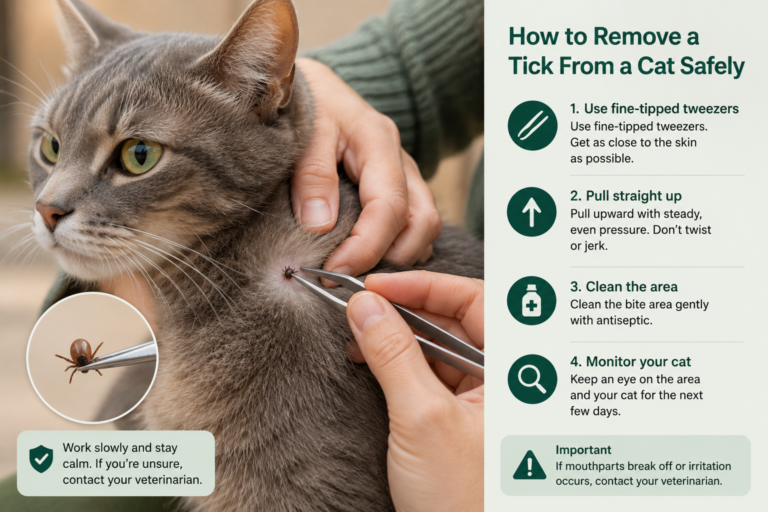
Tick Removal for Cats
How to Remove a Tick From a Cat Safely
To remove a tick from a cat, use clean fine-tipped tweezers, grasp the tick as close to the skin as possible and pull it away with slow, steady pressure. Avoid squeezing the tick’s body or forcing a frightened cat to remain still.
This guide explains how to prepare your cat, remove an attached tick step by step, care for the bite area and use the Tick Camera to inspect a small tick hidden beneath the fur.
How to Remove a Tick From a Cat at a Glance
Remove an attached tick promptly, but prepare everything before handling your cat.
- Move your cat to a quiet and well-lit room.
- Ask another person to help when useful.
- Put on disposable gloves.
- Part the fur completely around the tick.
- Confirm that the object is an attached tick.
- Use clean fine-tipped tweezers.
- Grasp the tick as close to the skin as possible.
- Pull slowly with steady, even pressure.
- Avoid squeezing or crushing the tick’s body.
- Place the tick in a sealed container.
- Clean the attachment site and wash your hands.
- Check the rest of your cat for more ticks.
- Monitor the skin and your cat afterward.
Contact a veterinarian if the tick is attached near the eye, deep inside the ear, inside the mouth or in another location where removal cannot be performed safely.
What Do You Need to Remove a Tick From a Cat?
Prepare all equipment before bringing your cat into position.
- Clean fine-tipped tweezers or an appropriate tick-removal tool
- Disposable gloves
- Bright, even lighting
- A comb for long or thick fur
- Clean gauze or tissue
- A sealed container or adhesive tape
- A cat-safe skin-cleaning product when recommended
- Small treats
- A second person when useful
Fine-tipped tweezers
Fine tips help you reach the front of the tick close to the cat’s skin without gripping the enlarged abdomen.
Broad or blunt tweezers can make it more difficult to reach the attachment point accurately.
Tick-removal tool
A suitable commercial tick-removal tool may be used according to its instructions.
Different tools may require different movements. Follow the manufacturer’s directions rather than assuming every tool works like tweezers.
Disposable gloves
Wear gloves to reduce direct contact with the tick, the bite area and any material released if the tick is accidentally damaged.
Wash your hands thoroughly after removal even when gloves were used.
Good lighting
Use bright, even light so that the tick’s body and attachment point can be seen clearly.
Avoid shining a strong light directly into the cat’s eyes.
A second person
One person can calmly support and reassure the cat while the other parts the fur and removes the tick.
The helper should not pin the cat down tightly or hold it around the neck.
How to Keep Your Cat Calm During Tick Removal
Cats may quickly become restless when a sensitive or unfamiliar area is handled. Keep the procedure calm, brief and predictable.
Choose a quiet room
Close doors and windows and keep other pets and children away during the procedure.
Choose the right time
Handle the cat when it is relaxed, such as after eating or resting.
Avoid beginning when the cat is excited, frightened or preparing to go outside.
Begin with normal petting
Stroke the cat in familiar areas before gradually moving toward the tick.
Use treats
Offer small treats before and after removal when this helps the cat remain calm.
Let the cat remain in a natural position
The cat may stand, sit or lie on its side. Do not automatically force it onto its back.
Support rather than restrain tightly
A helper can place one hand gently near the chest or shoulders while keeping the cat comfortable.
Watch for signs of stress
Pause or stop if the cat:
- Flattens its ears
- Lashes its tail
- Growls or hisses
- Tries to escape
- Struggles forcefully
- Attempts to scratch or bite
- Shows signs of pain
Seek veterinary help when safe handling is not possible.
How to Remove a Tick From a Cat Step by Step
Use controlled movements and avoid repeatedly touching or squeezing the tick.
1. Wash your hands and put on gloves
Clean your hands and wear disposable gloves when available.
2. Position your cat comfortably
Choose a position that gives you a clear view without tightly restraining the cat or stretching a limb unnaturally.
3. Expose the entire tick
Part the fur until you can see the tick’s body and the point where it meets the skin.
Use a comb when helpful. Do not cut close to an unidentified lump when the skin is not completely visible.
4. Confirm that it is a tick
Look for a distinct oval or rounded body and small legs near the front or sides.
Nipples, skin tags, scabs, warts and other skin features can be mistaken for ticks.
5. Find the attachment point
Locate the narrow area where the front of the tick meets the cat’s skin.
The larger oval or rounded section is the tick’s body. Avoid gripping this part when possible.
6. Position the tweezers close to the skin
Place the fine tips around the tick as close to the skin’s surface as possible.
Avoid trapping fur or pinching the cat’s skin between the tweezer tips.
7. Grip the tick securely
Apply enough pressure to hold the tick without unnecessarily squeezing or crushing the body.
8. Pull slowly and steadily
Pull the tick directly away from the skin using slow, steady and even pressure.
Do not jerk the tweezers. When using ordinary fine-tipped tweezers, avoid deliberately twisting the tick.
9. Continue until the tick releases
Maintain controlled pressure rather than repeatedly releasing and re-gripping the tick.
10. Move the tick away from your cat
Place it directly into a sealed container or secure it inside adhesive tape.
Do not leave the tick loose on the floor, furniture or grooming surface.
11. Inspect the attachment site
Check that the main body is no longer attached.
A tiny dark point may remain if a small part of the mouthparts has broken off.
12. Clean the area
Clean the attachment site using a method or product confirmed as safe for cats.
Do not use a human skin product unless a veterinarian has advised that it is appropriate.
13. Wash your hands and clean the tool
Wash your hands thoroughly after handling the tick. Clean the tweezers or removal tool according to its instructions.
14. Reward your cat
Offer calm praise and a treat. Allow the cat to leave the area and rest afterward.
What Should You Avoid When Removing a Tick?
Do not squeeze the tick’s swollen body
Grip close to the skin rather than around the enlarged abdomen.
Do not pull suddenly
A sharp movement can make the tweezers slip or cause the tick to break.
Do not twist with ordinary tweezers
Pull with slow, steady pressure unless the instructions for a specific removal tool state otherwise.
Do not burn the tick
Do not use a match, lighter, heated needle or another hot object near the cat.
Do not cover it with household substances
Do not apply petroleum jelly, oil, alcohol, nail polish, glue or other household products in an attempt to make the tick release.
Do not crush it with bare fingers
Avoid direct skin contact with the tick and its contents.
Do not cut around the tick
Never use scissors, nail clippers or a blade to cut an attached tick away from the skin.
Do not force a frightened cat
A struggling cat can injure itself or the handler. Contact a veterinarian instead.
Do not use a dog tick product on a cat
Some tick products intended for dogs contain ingredients that can be dangerous to cats.
Use only products specifically approved for cats and recommended for your cat by a veterinarian.
Do not delay removal for exact identification
A clear photograph may be useful, but a confirmed attached tick should be removed promptly.
When Should a Veterinarian Remove the Tick?
Professional removal is safer when the location or the cat’s behaviour makes home removal difficult.
Tick on or near the eyelid
Sudden movement can cause an eye injury. Contact a veterinarian if the tick is attached directly to the eyelid or very close to the eye.
Tick deep inside the ear
Do not insert tweezers, fingers, cotton swabs or camera accessories into the ear canal.
Tick inside the mouth
Seek veterinary help when a tick is attached to the tongue, gums, lips or another area inside the mouth.
Tick between the toes
Contact a veterinarian if the cat will not allow the paw to be handled or the tick cannot be seen clearly.
Tick in a painful or inflamed area
Increasing swelling, redness, discharge or pain can make removal more difficult and may indicate another problem.
Several attached ticks
A veterinary examination is advisable when multiple ticks are present or some cannot be reached safely.
Very small tick close to the skin
A tiny tick may be difficult to grasp without pinching the cat’s skin.
Cat cannot remain still
Do not continue when sudden movement creates a risk of injury.
Cat has a history of scratching or biting
Professional handling may be safer than attempting forceful restraint at home.
The lump may not be a tick
A veterinarian should inspect a bump that could be a nipple, skin tag, wart, mole, cyst or another skin growth.
What If the Tick Breaks During Removal?
A small part of the tick’s mouthparts can occasionally remain in the skin.
Do not panic
The main body has been removed, which is the most important immediate step.
Inspect the skin in bright light
A retained fragment may look like a tiny dark point or splinter.
Remove it only when it is easy to grasp
If the fragment is clearly visible and can be reached without digging into the skin, clean fine-tipped tweezers may sometimes be used.
Do not dig deeply into the skin
Repeated digging can cause pain, bleeding, irritation and infection.
Keep the area clean
Use only a cleaning method or product confirmed as safe for cats.
Prevent licking and scratching
Watch the cat and discourage repeated licking, chewing or scratching of the attachment site.
Contact a veterinarian if the area worsens
Seek veterinary advice if redness, swelling, warmth, pain or discharge increases.
What Should You Do After Removing the Tick?
After removal, clean the area, check the rest of the cat and monitor for changes.
Clean the attachment site
Use only a cleaning method or product known to be safe for cats.
Wash your hands
Wash thoroughly after handling the tick, tweezers or bite area.
Record the date
Note when the tick was found and removed.
Record the bite location
Write down the exact location, such as the left ear, neck, front paw or belly.
Take clear photographs
Photograph the removed tick and attachment site in bright, even lighting.
Check the entire cat
Finding one tick does not rule out additional ticks.
Inspect:
- The top of the head
- Around the eyes
- In and around both ears
- The cheeks, muzzle and chin
- Under the collar
- The neck and shoulders
- Under the front legs
- The chest and belly
- The groin
- All four legs
- The paws and spaces between the toes
- The base and underside of the tail
Inspect bedding and equipment
Check the collar, carrier, blankets and bedding for crawling ticks.
Monitor the skin
Watch for increasing redness, swelling, warmth, pain or discharge.
Monitor your cat’s health
Contact a veterinarian if your cat becomes unusually tired, stops eating, appears weak, develops breathing difficulty, seems painful or shows another concerning change.
Should You Keep the Removed Tick?
You may photograph the tick or keep it temporarily in a sealed container.
Photograph it clearly
Place it on a plain background or photograph it through a transparent container.
Use a sealed container
Keep the tick securely contained and away from children and pets.
Label the container
Include the date, bite location and geographic area where the cat may have encountered the tick.
Ask your veterinarian
Your veterinarian can advise whether identification or testing is useful in your location and situation.
Do not rely on tick testing alone
A pathogen detected in a tick does not prove that it was transmitted to the cat. A negative result does not replace observation or veterinary assessment.
How to Dispose of the Tick Safely
Do not crush the tick with bare fingers.
Possible options include:
- Placing it in a sealed container
- Wrapping it securely in adhesive tape
- Placing it in alcohol
- Following another method recommended by your veterinarian
Do not leave a live tick loose in a bin, on furniture or near the cat’s bedding.
How to Prevent Your Cat From Licking the Bite Area
Some cats repeatedly lick or scratch an irritated attachment site.
Observe your cat
Watch whether the cat repeatedly returns to the same area.
Keep the skin clean and dry
Follow your veterinarian’s instructions regarding cleaning and bathing.
Do not apply bitter sprays directly to the bite
Products intended to discourage licking may irritate broken skin and may be unsafe if swallowed.
Do not cover the area tightly
A bandage can trap moisture, restrict circulation or be chewed and swallowed.
Cover the area only when a veterinarian advises it.
Ask about protective equipment
A veterinary collar or recovery garment may be recommended when repeated licking prevents healing.
Seek advice for persistent irritation
Contact a veterinarian if the cat continues licking, biting or scratching the area.
When Should You Contact a Veterinarian?
Contact a veterinarian when removal cannot be completed safely or your cat develops concerning changes.
Seek veterinary advice if:
- The tick is near the eye or deep inside the ear
- The tick is attached inside the mouth
- Your cat will not allow safe handling
- Several ticks are attached
- The attachment site becomes increasingly swollen
- The area is painful, warm or produces discharge
- Your cat becomes unusually tired
- Your cat stops eating or drinking
- Your cat appears weak
- Your cat develops breathing difficulty
- Your cat shows poor coordination or trouble walking
- Your cat appears generally unwell
- You are unsure whether the lump is a tick
Seek urgent veterinary care for severe symptoms
Seek urgent assistance if your cat develops breathing difficulty, collapse, rapidly progressing weakness, poor coordination, paralysis or another serious neurological change.
Tell the veterinarian about the tick
Provide the removal date, attachment location, likely exposure area and any photographs you took.
Do not give human medication
Do not give antibiotics, painkillers or other human medicines unless specifically prescribed by a veterinarian.
How to Check Your Cat for More Ticks
Complete a systematic head-to-tail check after removing the first tick.
Start with the head
Inspect the forehead, cheeks, muzzle, chin and areas around the eyes.
Inspect both ears
Look at the outer ear, visible inner flap and folds around the base.
Remove the collar
Check the entire neck and all skin covered by the collar.
Run your hands over the coat
Feel slowly for small, firm or seed-like bumps close to the skin.
Inspect the chest, belly and groin
Check these areas only when the cat tolerates handling.
Check every paw
Inspect around the paw pads and between the toes.
Finish with the tail
Check the base, sides, underside and surrounding coat.
Common Mistakes When Removing a Tick From a Cat
Gripping the swollen abdomen
Place fine-tipped tweezers close to the skin rather than around the widest part of the tick.
Pulling too quickly
Use slow and steady pressure instead of a sudden jerk.
Twisting with ordinary tweezers
Pull steadily unless the instructions for a specific removal tool state otherwise.
Using petroleum jelly or oil
Do not coat the tick with household substances before removal.
Trying to burn the tick
Heat can injure the cat and is not an appropriate removal method.
Touching the tick with bare hands
Wear gloves when possible and wash your hands afterward.
Pulling at an unidentified lump
Nipples, skin tags, scabs and other growths can be mistaken for ticks.
Forcing a frightened cat
Stop and seek veterinary assistance when safe handling is not possible.
Using a dog tick treatment
Never apply a product intended for dogs unless a veterinarian has specifically confirmed that it is safe for your cat.
Forgetting to inspect the rest of the coat
More than one tick may be present.
Ignoring later symptoms
Continue monitoring your cat after the tick has been removed successfully.
Frequently Asked Questions About Removing Ticks From Cats
What is the safest way to remove a tick from a cat?
Use clean fine-tipped tweezers, grasp the tick close to the cat’s skin and pull it away slowly with steady pressure. Avoid squeezing or crushing the body.
Can I remove a tick from my cat myself?
A visible and accessible tick can sometimes be removed at home when the cat remains calm. Contact a veterinarian if the tick is in a sensitive location or the cat cannot be handled safely.
Should I twist the tick when removing it?
Do not deliberately twist when using ordinary fine-tipped tweezers. Follow the manufacturer’s directions when using a specially designed tick-removal tool.
Can I use petroleum jelly to remove a tick?
No. Do not cover the tick with petroleum jelly, oil, nail polish or another household product.
What if the tick’s mouthparts remain in my cat’s skin?
Do not dig deeply into the skin. Keep the area clean and contact a veterinarian if redness, swelling, pain or discharge increases.
What should I put on the skin afterward?
Use only a cleaning method or product known to be safe for cats. Ask your veterinarian when you are unsure.
Can I use my dog’s tick product on my cat?
No product intended for dogs should be used on a cat unless a veterinarian has specifically confirmed that it is safe. Some ingredients can be highly dangerous to cats.
Should I keep the tick?
You may photograph it or keep it temporarily in a sealed container. Ask your veterinarian whether identification would be useful.
How soon should an attached tick be removed?
An attached tick should be removed as soon as it can be done safely and correctly.
When should I contact a veterinarian?
Contact a veterinarian if your cat appears unwell, has several attached ticks, develops weakness or breathing difficulty, cannot be handled safely or the tick cannot be removed completely.
Your Next Step
Sources
This guide was prepared using information from recognized veterinary and public-health organizations.
Merck Veterinary Manual: Ticks of Cats ↗
Merck Veterinary Manual: Tick Removal ↗
Companion Animal Parasite Council: Tick Guidelines ↗
Centers for Disease Control and Prevention: Preventing Ticks on Pets ↗
American Veterinary Medical Association: External Parasites ↗
American Veterinary Medical Association: Safe Use of Flea and Tick Preventive Products ↗
Learn more about our research and review process in our Editorial Policy and Sources and References.