
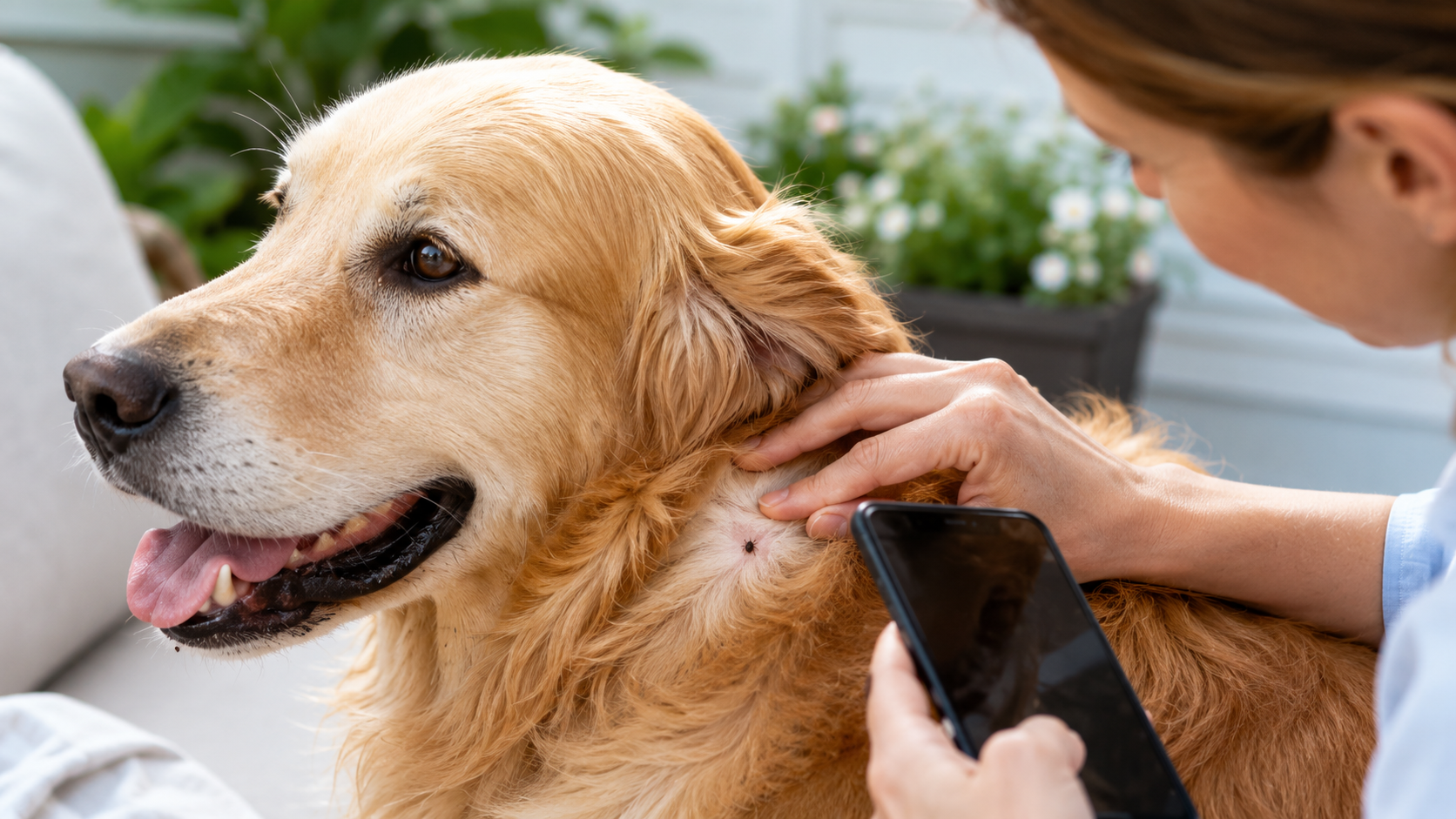
Tick Checks for Dogs
How to Check a Dog for Ticks
Ticks can be difficult to find in a dog’s coat, especially when the fur is thick or long. A calm, systematic check helps you inspect the ears, neck, belly, paws and other common hiding places.
This guide explains where ticks commonly hide on dogs, how to check the coat and skin step by step and how the Tick Camera can help you inspect small or hard-to-see spots.
How to Check a Dog for Ticks at a Glance
Choose a bright and quiet place. Run your hands slowly over the coat and part the fur wherever you feel a small bump or notice a dark spot.
- Check the head, muzzle and areas around the eyes.
- Inspect inside and around both ears.
- Check the neck and underneath the collar or harness.
- Run your hands over the shoulders, back and sides.
- Inspect the armpits, chest, belly and groin.
- Check all four legs and the spaces between the toes.
- Inspect around the tail and underneath the tail.
- Look closely at any small bump before trying to remove it.
A lump in the coat is not automatically a tick. The guide How to Identify a Tick explains common tick features and possible look-alikes.
Where Do Ticks Commonly Hide on Dogs?
Ticks may attach almost anywhere on a dog. Areas with thinner skin, folds, warmth or limited visibility deserve particular attention.
In and around the ears
Inspect the outer surface of each ear, the folds around the base and the visible parts of the ear flap.
Do not insert tweezers, cotton swabs or other objects into the ear canal. Contact a veterinarian if a tick appears to be deep inside the ear.
Around the eyes and eyelids
Look carefully around the eyes and along the eyelid edges. Small ticks in this area may resemble a dark speck or small raised bump.
Do not attempt removal close to the eye unless you can do so safely. Veterinary help is the safer option when the tick is attached directly to an eyelid or very close to the eye.
Muzzle, lips and chin
Check the muzzle, chin and skin around the lips. Gently lift loose skin folds where appropriate, but do not force the mouth open.
Neck and collar area
Remove the collar or harness and inspect the entire neck. Check underneath buckles, straps and areas where equipment rests against the coat.
Shoulders, back and sides
Run your fingertips slowly over the shoulders, back and sides. Part the fur whenever you feel a small lump or rough area.
Under the front legs
Raise each front leg gently and inspect the armpit and nearby skin. These warm, protected areas can be difficult to see without parting the fur.
Chest, belly and groin
Check the chest, underside, belly and groin. Ticks may be easier to see in areas where the fur is shorter or thinner.
Between the back legs
Inspect the inner thighs and the area between the back legs. Check nearby skin folds carefully.
Legs and joints
Run your hands down each leg and inspect around the elbows, knees and other joints.
Paws and between the toes
Check the tops and undersides of all paws. Separate the toes gently and inspect the spaces between them and around the paw pads.
Around and under the tail
Inspect the base of the tail, the underside and the surrounding skin. Lift the tail gently without pulling or causing discomfort.
How to Check a Dog for Ticks Step by Step
A fixed routine makes the check easier and reduces the chance of skipping an area.
1. Choose a quiet and well-lit place
Use a calm room with bright, even lighting. Make sure the dog is standing, sitting or lying comfortably.
Have treats, a comb and any other useful equipment within reach before you begin.
2. Remove the collar and harness
Ticks can hide beneath collars, harnesses and straps. Remove these items and inspect them before checking the dog’s neck and shoulders.
3. Begin with the head
Inspect the muzzle, chin, cheeks and top of the head. Look around the eyes and along the visible edges of the eyelids.
4. Check both ears carefully
Examine the outside, inside surface and base of each ear flap. Look closely at folds and areas covered by long ear hair.
Stop and contact a veterinarian if the dog appears painful or if a possible tick is located deep in the ear.
5. Check the neck and shoulders
Part the fur around the entire neck and inspect the skin underneath. Continue over the shoulders and upper back.
6. Run your hands over the back and sides
Use gentle fingertip pressure and move slowly along the coat. Small attached ticks may feel like seeds or tiny raised bumps.
Whenever you feel a lump, part the fur and inspect the skin rather than relying on touch alone.
7. Inspect the chest, armpits and belly
Check the chest and raise each front leg gently to inspect the armpits.
Continue along the belly and look for small dark, brown or grey spots attached to the skin.
8. Check the groin and back legs
Inspect the groin, inner thighs and areas between the back legs. Move slowly and stop if the dog becomes uncomfortable.
9. Check every paw
Inspect the top, underside and pads of each paw. Separate the toes gently and look between them.
Check around the nails and in any longer fur growing between the pads.
10. Inspect the tail area
Check the base, sides and underside of the tail. Inspect the nearby skin and areas where the coat is thick.
11. Recheck any suspicious bump
Use bright lighting and part the fur completely around the area. Look from more than one angle before attempting removal.
Have You Found a Small Lump in Your Dog’s Coat?
A tick may feel like a small seed, bead or raised bump attached to the skin. Its appearance can vary depending on its species, size and whether it has been feeding.
Other things can feel or look similar, including:
- Skin tags
- Nipples
- Scabs
- Warts
- Moles or pigmented skin
- Small cysts or other skin lumps
- Dirt or plant material caught in the coat
Do not twist, squeeze or pull forcefully at a lump that has not been identified.
Instead:
- Part the fur completely around the area.
- Move into brighter lighting.
- Look for a separate body and visible legs.
- Inspect the point where the object meets the skin.
- Use magnification or the Tick Camera when helpful.
- Seek veterinary advice if the area remains unclear.
How to Keep Your Dog Calm During the Check
A relaxed dog is easier to inspect safely. Move slowly and avoid turning the check into a struggle.
Begin with familiar handling
Start by stroking the dog in areas it is comfortable having touched. Gradually move toward the ears, paws and underside.
Use rewards
Offer small treats and calm praise during the check. Rewarding cooperation can make future inspections easier.
Check one area at a time
Follow a consistent order and complete one body area before moving to the next.
Take breaks when necessary
Pause if the dog becomes restless, anxious or uncomfortable. Continue later rather than forcing the check.
Ask another person to help
One person can calmly hold or reward the dog while the other parts the fur and inspects the skin.
Stop if the dog shows pain or aggression
Do not risk being bitten. Contact a veterinarian or experienced veterinary professional if the dog cannot be examined safely.
When Should You Check Your Dog for Ticks?
Dogs that spend time outdoors should be checked regularly, particularly after walking through grassy, wooded or brush-covered areas.
A tick check is especially useful after:
- Woodland walks
- Hiking
- Walking through long grass
- Visiting parks or fields
- Camping
- Hunting or working outdoors
- Playing in gardens or brush
- Travel to areas where ticks are common
Check your dog after outdoor activity
Perform the check before the dog settles on furniture, beds or carpets. Unattached ticks may still be crawling through the coat.
Inspect collars, harnesses and bedding
Check equipment and bedding as well as the dog. A tick may be carried indoors without being attached.
Use regular preventive care
Ask your veterinarian which tick-prevention product is appropriate for your dog, location, health and lifestyle. Use products only according to their instructions.
Found an Attached Tick on Your Dog: What Next?
An attached tick should be removed carefully. Wear gloves when possible and use fine-tipped tweezers or an appropriate tick-removal tool.
Grasp the tick as close to the skin as possible and pull it out with slow, steady pressure. Avoid squeezing, crushing or twisting the tick’s body.
After removal, these guides may also be helpful:
What If Tick Mouthparts Stay in the Skin? →
Tick Bites: What to Look For →
How to Identify the Removed Tick →
Clean the area and your hands
Clean the bite area according to veterinary guidance and wash your hands after handling the tick.
Monitor your dog
Watch the bite area and your dog’s general condition. Contact a veterinarian if the area becomes increasingly swollen, painful or irritated, or if the dog appears unwell.
Ask for help when several ticks are present
Contact a veterinarian if the dog has many attached ticks, if ticks are located in sensitive areas or if safe removal is not possible.
Common Mistakes When Checking a Dog
Looking only at the surface of the coat
Ticks may be hidden close to the skin. Part the fur whenever you feel a bump or notice a dark area.
Forgetting the ears and collar area
The ears, neck and areas beneath collars and harnesses are easy to overlook.
Skipping the paws
Ticks may attach between the toes or around the paw pads. Check every paw individually.
Relying only on touch
Nipples, skin tags and other normal features can feel similar to ticks. Always inspect the skin visually.
Pulling at an unidentified lump
Do not pull or cut a lump until you have confirmed that it is an attached tick.
Using heat, petroleum jelly or household chemicals
Do not burn the tick or cover it with substances intended to make it detach. Use appropriate tweezers or a tick-removal tool instead.
Forcing an anxious or painful dog
A dog that is frightened or in pain may bite. Stop and seek veterinary assistance when the check cannot be performed safely.
Frequently Asked Questions About Ticks on Dogs
Where are ticks commonly found on dogs?
Check in and around the ears, around the eyes, beneath the collar, under the front legs, between the back legs, around the tail and between the toes. The entire coat should still be inspected.
How do I check a dog with thick fur?
Run your fingertips slowly over the coat and part the fur wherever you feel a bump. Work in small sections and inspect the skin underneath in bright light.
What does a tick feel like on a dog?
An attached tick may feel like a small seed, bead or firm raised bump. Touch alone cannot confirm that a lump is a tick.
Should I check my dog after every walk?
Regular checks are particularly important after walks through wooded, grassy or brush-covered areas. Dogs that frequently go outdoors may benefit from a daily check.
Can ticks hide between a dog’s toes?
Yes. Separate the toes gently and inspect the spaces between them, the paw pads and the areas around the nails.
Can I remove a tick from my dog myself?
A visible and accessible tick can often be removed using fine-tipped tweezers or an appropriate tick-removal tool. Seek veterinary help for ticks in sensitive locations or when removal cannot be performed safely.
What should I do if a tick is inside my dog’s ear?
Do not insert tools deep into the ear canal. Contact a veterinarian for safe examination and removal.
When should I contact a veterinarian after a tick bite?
Contact a veterinarian if your dog appears unwell, develops weakness, fever, reduced appetite, unusual pain, lameness or other concerning changes, or if the bite area becomes increasingly irritated.
Your Next Step
Sources
This guide was prepared using information from recognized veterinary and public-health organizations.
Centers for Disease Control and Prevention: Preventing Ticks on Pets ↗
Centers for Disease Control and Prevention: How to Check Your Pet for Ticks ↗
American Veterinary Medical Association: External Parasites ↗
American Veterinary Medical Association: Safe Use of Flea and Tick Preventive Products ↗
Learn more about our research and review process in our Editorial Policy and Sources and References.